

A Sri Lanka work visa is formally known as an Employment Category Residence Visa. Foreign nationals who want to work in Sri Lanka must obtain this visa before starting any employment. The process requires employer sponsorship, prior approval from the Department of Immigration and Emigration, and entry on an appropriate visa type. This guide covers every step, from eligibility to fees and processing times.
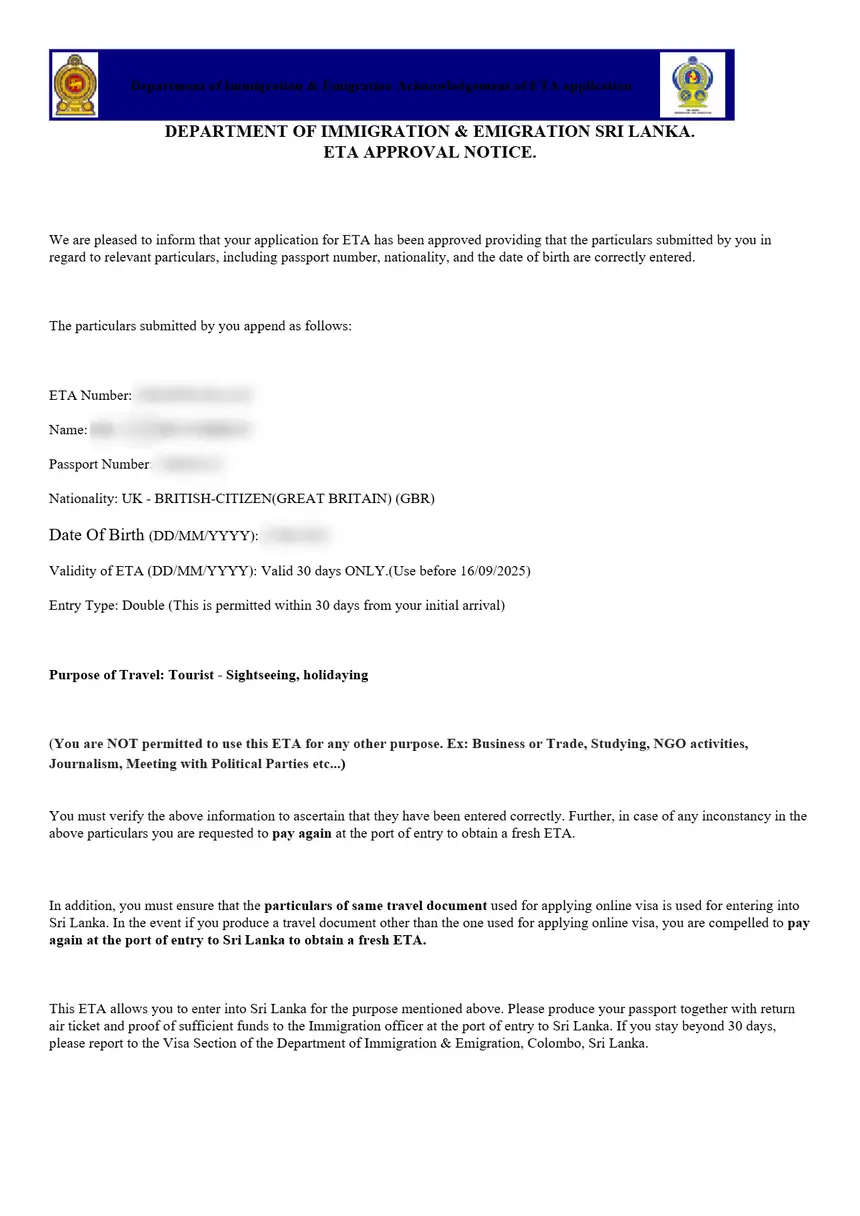
For short-term visits such as tourism or business meetings, the Sri Lanka ETA is sufficient. However, any form of paid or unpaid employment requires a dedicated work visa.
What Is a Sri Lanka Work Visa?
Sri Lanka does not issue a standalone “work visa” as a single document. Instead, foreign workers enter the country through a two-stage process:
- Entry Visa – A short-term visa issued by a Sri Lankan diplomatic mission abroad, allowing the individual to enter the country.
- Employment Category Residence Visa – The actual work authorization, granted after arrival by the Department of Immigration and Emigration in Colombo.
The Residence Visa is what authorizes you to live and work in Sri Lanka. It is typically issued for one year at a time and is renewable annually as long as the employment relationship continues.
Who Needs a Work Visa for Sri Lanka?
Any foreign national who intends to engage in employment in Sri Lanka must obtain a work visa. This applies regardless of:
- The sector or industry
- The job role or seniority level
- Whether the work is full-time, part-time, or contract-based
- The duration of employment
Employers are legally responsible for ensuring that international hires secure the proper permits before commencing work. Working on a tourist visa or business visa is a violation of Sri Lankan immigration law.
Types of Employment Category Residence Visas
The Department of Immigration and Emigration recognizes several sub-categories under the Employment Category. Each has specific eligibility criteria:
| Category | Eligible Applicants |
|---|---|
| Government-approved projects | Professional personnel whose services are required for projects approved by the government |
| BOI companies | Expatriate personnel employed in projects under the Board of Investment of Sri Lanka |
| Banking sector | Personnel employed at banks and their dependents |
| Private companies | Personnel employed in registered private companies or institutions |
| Colombo Port City | Personnel employed in the Colombo Port City special economic zone |
In addition to the Employment Category, there are related residence visa categories that may apply to certain workers:
- Investor Category – For those investing monetary capital or engaging in business activities in Sri Lanka
- Religious Category – For clergy and those engaged in religious activities
- NGO/INGO Category – For personnel attached to non-governmental or international non-governmental organizations
Sri Lanka Work Visa Requirements
To apply for an Employment Category Residence Visa, both the employer and the employee must prepare specific documentation.
Employer Requirements
The Sri Lankan employer must provide:
- Company registration documents
- Board of Investment (BOI) approval, if applicable
- Tax registration and compliance certificates
- Sector-specific licenses demonstrating authorization to operate
- A sponsorship or invitation letter outlining the role, duration, salary, and confirmation of immigration compliance responsibility
Employee Requirements
The foreign worker must provide:
- Valid passport with at least six months validity from the date of arrival in Sri Lanka
- Two unused visa pages in the passport
- Completed Visa Application Form “B”
- Two recent passport-size photographs (taken within the last six months)
- Copy of the approval from the Controller General of Immigration and Emigration
- Police clearance certificate from the home country or recent country of residence
- Educational and professional qualifications (degrees, certifications)
- Medical reports, if requested
- Employment contract or offer letter detailing duties, salary, and benefits
For non-British or non-EU citizens applying from the UK, a valid UK visa is also required.
How to Apply for a Sri Lanka Work Visa
The application process involves coordinated steps between the employer and the employee, typically spanning 6 to 8 weeks.
Step 1: Employer Preparation
The employer identifies the role, confirms the need for a foreign hire, and prepares corporate documentation. This includes ensuring the position cannot be readily filled by a local candidate and that the proposed salary aligns with Sri Lankan labor standards.
Step 2: Obtain Prior Approval
Before the employee can apply for an Entry Visa, the employer must obtain prior approval from the Controller General of Immigration and Emigration in Sri Lanka. This is a mandatory prerequisite.
Step 3: Entry Visa Application
With the Controller’s approval in hand, the employee applies for an Entry Visa at the nearest Sri Lankan embassy or consulate. The application includes Form “B”, passport, photographs, and the approval letter.
Step 4: Arrival in Sri Lanka
Once the Entry Visa is issued, the employee travels to Sri Lanka. The Entry Visa allows the individual to enter the country and begin the residence visa application process.
Step 5: Residence Visa Application
After arrival, the employer submits the Employment Category Residence Visa application to the Department of Immigration and Emigration in Battaramulla, Colombo. The application package includes all employee and employer documents.
Step 6: Ministry Review (if applicable)
For certain sectors such as healthcare, education, or regulated industries, additional clearances or endorsements from line ministries may be required before the residence visa is granted.
Step 7: Visa Issuance
Once the Department is satisfied with the application, the Residence Visa endorsement is placed in the employee’s passport. The visa is tied to the specific employer and role.
Sri Lanka Work Visa Fees
| Fee Type | Amount |
|---|---|
| Residence Visa | LKR 20,000 per year |
| Entry Visa | Varies by nationality; consult the nearest Sri Lankan diplomatic mission |
The Residence Visa fee is paid at the Department of Immigration and Emigration. Payment counters close at 3:30 PM, and the office operates Monday to Friday from 8:30 AM to 2:00 PM for application acceptance.
For comparison, the Sri Lanka ETA fee for tourist and business visits is significantly lower, as it does not grant employment rights.
Processing Time
Processing times vary depending on the visa category, the applicant’s nationality, and whether additional ministry approvals are needed:
| Visa Type | Processing Time |
|---|---|
| Employment Residence Visa | 1 to 3 months |
| Permanent Residence | 6 to 12 months |
| Short-Term Business Visa | 2 to 4 weeks |
The typical timeline follows this pattern:
- Weeks 1-2: Employer prepares corporate documents and sponsorship letter; employee gathers personal documents
- Week 3: Entry Visa application submitted at the Sri Lankan mission abroad
- Week 4: Employee travels to Sri Lanka after Entry Visa is issued
- Weeks 5-8: Residence Visa application is reviewed and approved by the Department
Starting the process at least two to three months before the intended start date is recommended to account for potential delays.
Renewal and Duration
Employment Category Residence Visas are granted for a limited period, typically one year, and must be renewed before expiry if the employment continues. Key points about renewal:
- Renewals require updated employer letters confirming the role and salary remain compliant
- Police or medical clearances may need to be refreshed
- Start the renewal process at least 60 to 90 days before the visa expiry date
- Changes in employment (employer, role, or location) generally require a new approval process
The Residence Visa is a multiple-entry visa, allowing the holder to travel in and out of Sri Lanka during the validity period without additional entry permits.
Important Restrictions
Holders of an Employment Category Residence Visa should be aware of these conditions:
- The visa is tied to the specific employer and role listed on the application
- Engaging in any activity other than what is specified in the visa conditions is prohibited
- Changing employers requires a new approval process
- The visa does not automatically lead to permanent residency or citizenship
- Violations of visa conditions can result in deportation and future entry bans
Digital Nomads and Remote Workers
As of 2026, Sri Lanka does not offer a specific visa category for digital nomads. Individuals intending to work remotely from Sri Lanka should explore available visa options such as tourist or business visas, and ensure compliance with the terms of each visa type. A standard tourist visa or ETA does not authorize employment, even for a foreign employer.
Those seeking to work remotely for extended periods may consider the Investor Category if establishing a business presence in Sri Lanka, though this requires actual capital investment rather than simply working online.
Comparison: Work Visa vs. Business Visa vs. ETA
| Feature | Work Visa (Residence) | Business Visa | ETA (Tourist/Business) |
|---|---|---|---|
| Employment allowed | Yes | No | No |
| Duration | 1 year (renewable) | Short-term | 30 days |
| Application method | In-country (after Entry Visa) | Embassy or online | Online |
| Employer sponsorship | Required | Not required | Not required |
| Typical cost | LKR 20,000/year | Varies | Varies by nationality |
For short business meetings, conferences, or exploratory visits, a Business Visa or Sri Lanka ETA is appropriate. For actual employment, the full Residence Visa process is mandatory.
Understanding the Sri Lanka ETA requirements is helpful for initial entry, but workers must transition to the Residence Visa category for long-term employment.
FAQs About Sri Lanka Work Visa
Can I work in Sri Lanka on a tourist visa?
No. Working on a tourist visa or ETA is a violation of Sri Lankan immigration law. Any form of employment, whether paid or unpaid, requires an Employment Category Residence Visa.
How long does it take to get a Sri Lanka work visa?
The typical processing time for an Employment Category Residence Visa is 1 to 3 months after all documents have been submitted. This includes the Entry Visa application at a Sri Lankan mission abroad and the Residence Visa application in Colombo.
How much does a Sri Lanka work visa cost?
The Residence Visa fee is LKR 20,000 per year (approximately USD 60-70). Entry Visa fees vary by nationality and should be confirmed with the nearest Sri Lankan diplomatic mission.
Can I change employers on a Sri Lanka work visa?
No. The Employment Category Residence Visa is tied to the specific employer and role. Changing employers requires a new approval process from the Department of Immigration and Emigration.
Do I need employer sponsorship for a Sri Lanka work visa?
Yes. Employer sponsorship is mandatory. The Sri Lankan company must be properly registered, tax-compliant, and provide a detailed sponsorship letter. Individual applicants cannot self-sponsor for a work visa.
Can I bring my family on a Sri Lanka work visa?
Yes. Dependents of Employment Category Residence Visa holders can apply for dependent residence visas. The employer’s sponsorship letter typically extends to cover dependents as well.
What is the difference between an Entry Visa and a Residence Visa?
An Entry Visa is a short-term visa that allows you to enter Sri Lanka. A Residence Visa is the actual authorization to live and work in the country. You must obtain the Entry Visa first, then apply for the Residence Visa after arrival.
Is there a digital nomad visa for Sri Lanka?
No. As of 2026, Sri Lanka does not offer a specific digital nomad visa. Remote workers should explore tourist, business, or investor visa options depending on their circumstances.