

What Is a Sri Lanka Transit Visa?
A Sri Lanka Transit Visa is a short-term entry permit issued to foreign nationals who need to pass through Sri Lanka on their way to another destination. It is designed for travelers with layovers or connecting flights who need to clear immigration, re-check baggage, or briefly exit the airport or seaport during their journey.
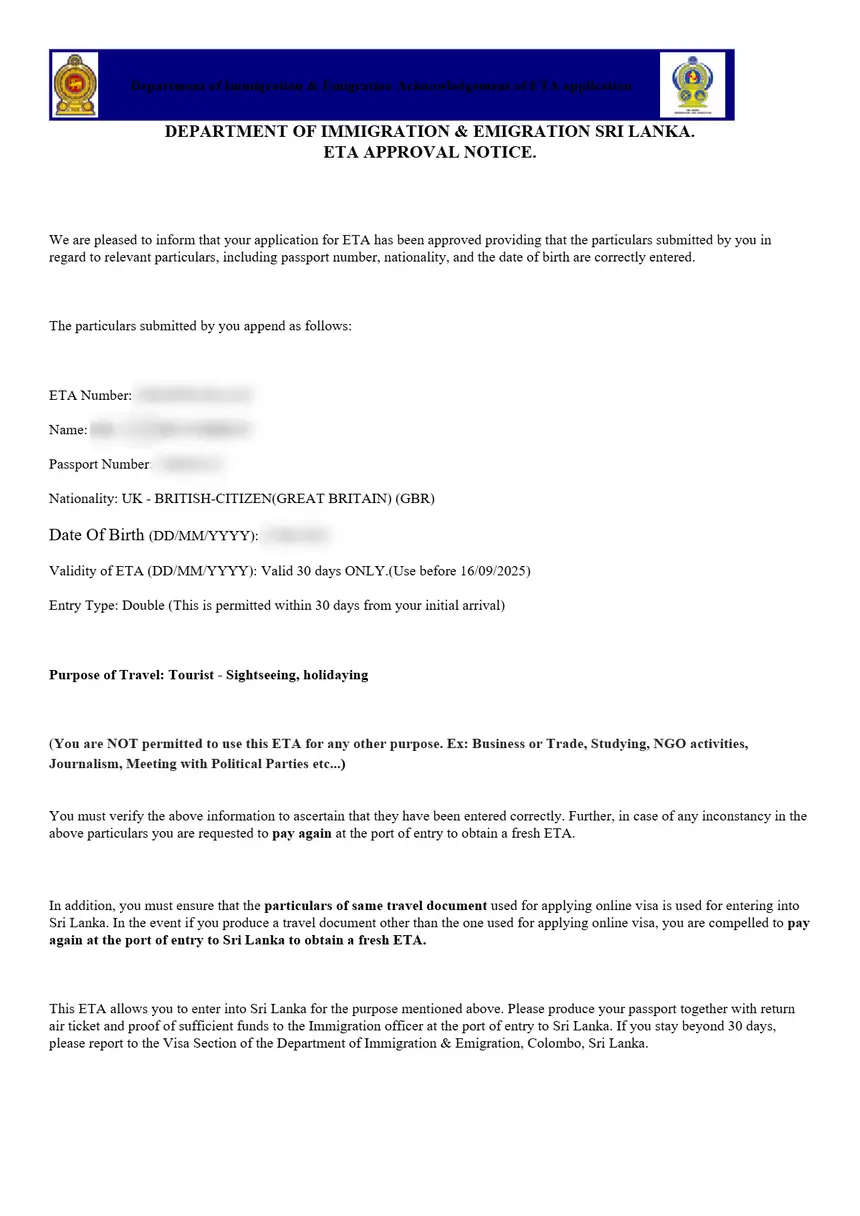
The transit visa is free of charge and valid for a maximum of two days (48 hours). It cannot be extended, and it does not permit you to stay in Sri Lanka beyond the allotted transit period. If your onward journey takes longer than two days, you will need to apply for a different visa category, such as the Sri Lanka ETA for tourists.
The transit visa is issued by the Department of Immigration and Emigration and can be applied for online through the official ETA portal at eta.gov.lk.
Who Needs a Transit Visa for Sri Lanka?
Whether you need a transit visa depends on your nationality and the nature of your layover:
-
Airside transit (under 24 hours): If your layover is less than 24 hours and you remain within the airport’s international transit area without passing through immigration, you generally do not need a transit visa. This applies to most connecting flights where you stay airside.
-
Transit requiring immigration clearance (up to 48 hours): If your layover exceeds 24 hours, you need to collect and re-check luggage, or you plan to leave the airport, you must obtain a transit visa before passing through immigration.
-
Nationals of Schedule A countries: Citizens of countries listed in Schedule A receive transit visa endorsements at the port of entry in Sri Lanka. This means they can obtain the transit visa upon arrival without prior application.
-
Nationals of other countries: If your country is not in Schedule A, you must apply for the transit visa in advance through the official ETA portal or at a Sri Lankan embassy or consulate before traveling.
Sri Lanka Transit Visa Requirements
Documents Needed
To apply for a Sri Lanka Transit Visa, you will need:
- Valid passport with at least six months of remaining validity from your date of departure from Sri Lanka
- Proof of onward travel – a confirmed air ticket or sea passage documentation showing your next destination
- Completed application submitted through the ETA portal (for online applications) or Form C (for embassy applications)
- Visa for your destination country (if applicable) – proof that you are authorized to enter your final destination
For sea transit passengers, additional documents may include:
- A letter from your agent in Sri Lanka
- Documentation confirming your destination country and relevant visa particulars
Passport Validity
Your passport must have a minimum validity of six months from the date you plan to leave Sri Lanka. This is a strict requirement enforced at immigration. If your passport expires within six months, renew it before applying for the transit visa.
How Long Is the Transit Visa Valid?
The Sri Lanka Transit Visa is valid for a maximum of two days (48 hours) from the date of entry. This period cannot be extended under any circumstances.
If you anticipate needing more time in Sri Lanka, consider applying for a tourist visa through the ETA instead. The tourist ETA allows stays of up to 30 days with double entry and can be extended up to six months while in the country.
How to Apply for a Sri Lanka Transit Visa
The application process is straightforward:
Step 1: Visit the official ETA portal at eta.gov.lk.
Step 2: Select “Transit” as your travel purpose.
Step 3: Fill in your personal details, passport information, and travel itinerary.
Step 4: Upload proof of your onward travel (confirmed ticket to your next destination).
Step 5: Submit the application. For most nationalities, processing is quick – often completed within 24 hours.
Step 6: Once approved, you will receive the transit visa electronically. Print a copy or save it on your mobile device to present at immigration upon arrival.
Nationals of countries not in Schedule A should apply well in advance of their travel date. While online processing is typically fast, applying at least one week before departure is recommended to account for any delays. Check the ETA requirements for more details on the application process.
Sri Lanka Transit Visa vs. Airside Transit
It is important to understand the difference between a transit visa and airside transit:
| Feature | Airside Transit | Transit Visa |
|---|---|---|
| Duration | Under 24 hours | Up to 48 hours |
| Leaving the airport | No – must stay in transit area | Yes – can pass through immigration |
| Visa required | Generally no | Yes |
| Cost | Free | Free |
| Baggage re-check | Not possible (stays airside) | Possible |
| Can be extended | N/A | No |
If your connecting flight departs within a few hours and you do not need to collect your luggage or leave the transit zone, you likely do not need a transit visa. However, if you have a long layover and want to explore Colombo or need to re-check bags at a different terminal, the transit visa is required.
Activities Not Permitted on a Transit Visa
The Sri Lanka Transit Visa is strictly for transit purposes. The following activities are not allowed:
- Employment – whether paid or unpaid
- Self-employment or freelance work
- Business activities of any kind
- Extended stays through frequent or successive transit visits
- Tourism beyond transit – the visa is not a substitute for a tourist visa
If you plan to engage in any of these activities, you will need the appropriate visa. For business travel, see the Sri Lanka Business Visa guide. For leisure visits, apply for a tourist ETA instead.
For full details on visa categories and fees, refer to our main Sri Lanka ETA guide.
Sri Lanka Transit Visa Fees and Processing
The Sri Lanka Transit Visa is one of the few visa types that is completely free. There is no application fee, no processing fee, and no hidden charges regardless of your nationality.
Processing times depend on how you apply:
- Online via ETA portal: Typically processed within 24 hours, often within a few hours
- At a Sri Lankan embassy: Processing times vary by location, usually 2-5 business days
- At port of entry (Schedule A nationals): Issued immediately upon arrival
There are no priority or expedited processing options since the standard processing is already fast for online applications.
Common Transit Scenarios
Understanding when you need a transit visa is easier with real-world examples:
Scenario 1 – Short layover: You are flying from London to Sydney with a 4-hour connection at Bandaranaike International Airport (CMB). Your bags are checked through to Sydney, and you stay in the transit area. No transit visa needed.
Scenario 2 – Overnight layover: You are flying from Dubai to Singapore with a 16-hour overnight layover in Colombo. You want to leave the airport and stay at a hotel. Transit visa required.
Scenario 3 – Airline change: You arrive in Colombo on one airline and depart on a different airline the next day. You need to collect your luggage and check in again. Transit visa required.
Scenario 4 – Cruise stopover: You are arriving by sea as part of a cruise and need to disembark briefly before the ship continues. Transit visa required (with additional sea transit documentation).
Tips for Transit Travelers
- Apply online before departure even if your nationality qualifies for on-arrival endorsement. Having the visa pre-approved speeds up the immigration process.
- Keep your onward ticket handy – immigration officers will ask for proof of your onward journey when you arrive.
- Plan for the 48-hour limit – if there is any chance your onward flight could be delayed beyond 48 hours, consider applying for a tourist ETA instead for more flexibility.
- Currency exchange – if you plan to leave the airport during your transit, Sri Lankan rupees are needed for local expenses. ATMs and exchange counters are available at the airport.
- Transport from the airport – Bandaranaike International Airport is approximately 30 km north of Colombo. Taxis and ride-hailing services are available if you want to briefly explore the city during a long layover.