

What Is the Sri Lanka ETA?
Sri Lanka ETA (Electronic Travel Authorization) is a mandatory digital entry permit that replaces traditional visa stamps for most foreign nationals visiting Sri Lanka. This electronic system, managed by the Department of Immigration and Emigration, allows travelers to obtain entry authorization entirely online before departure.
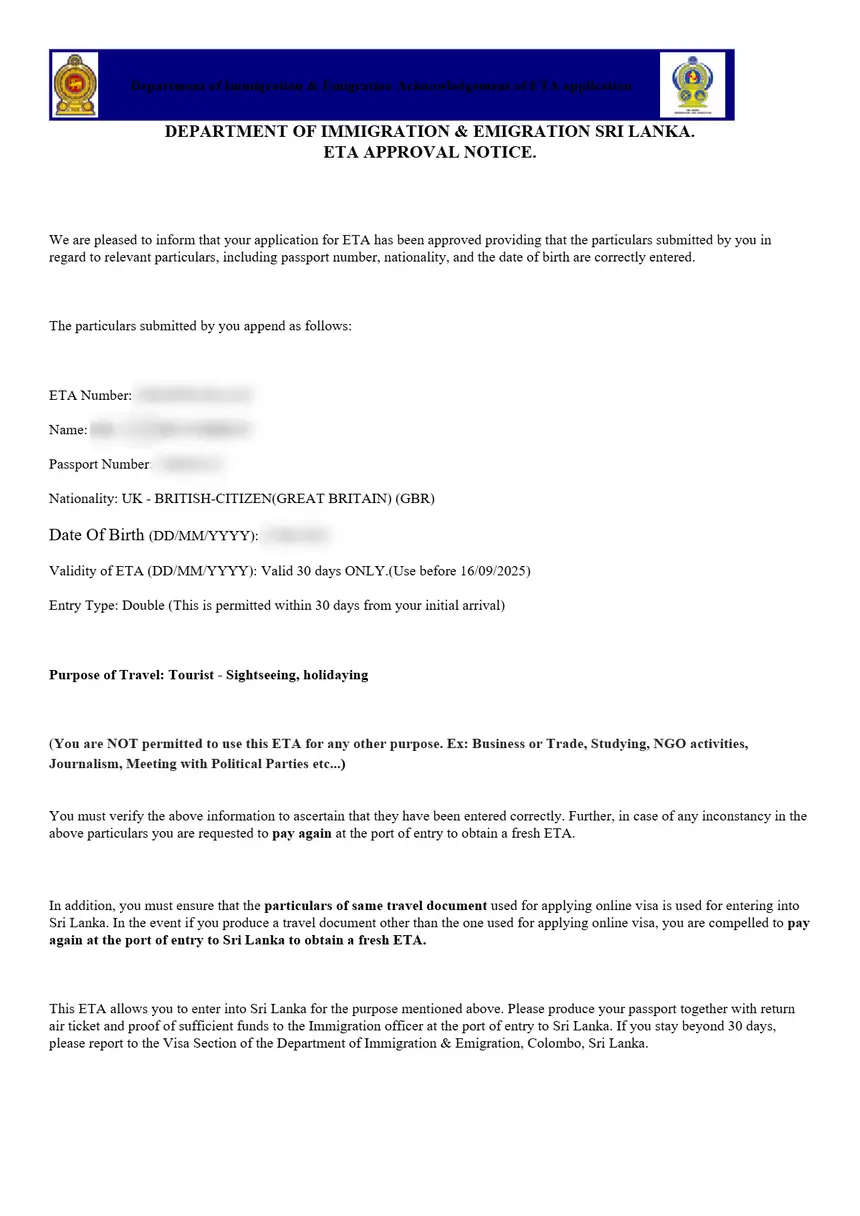
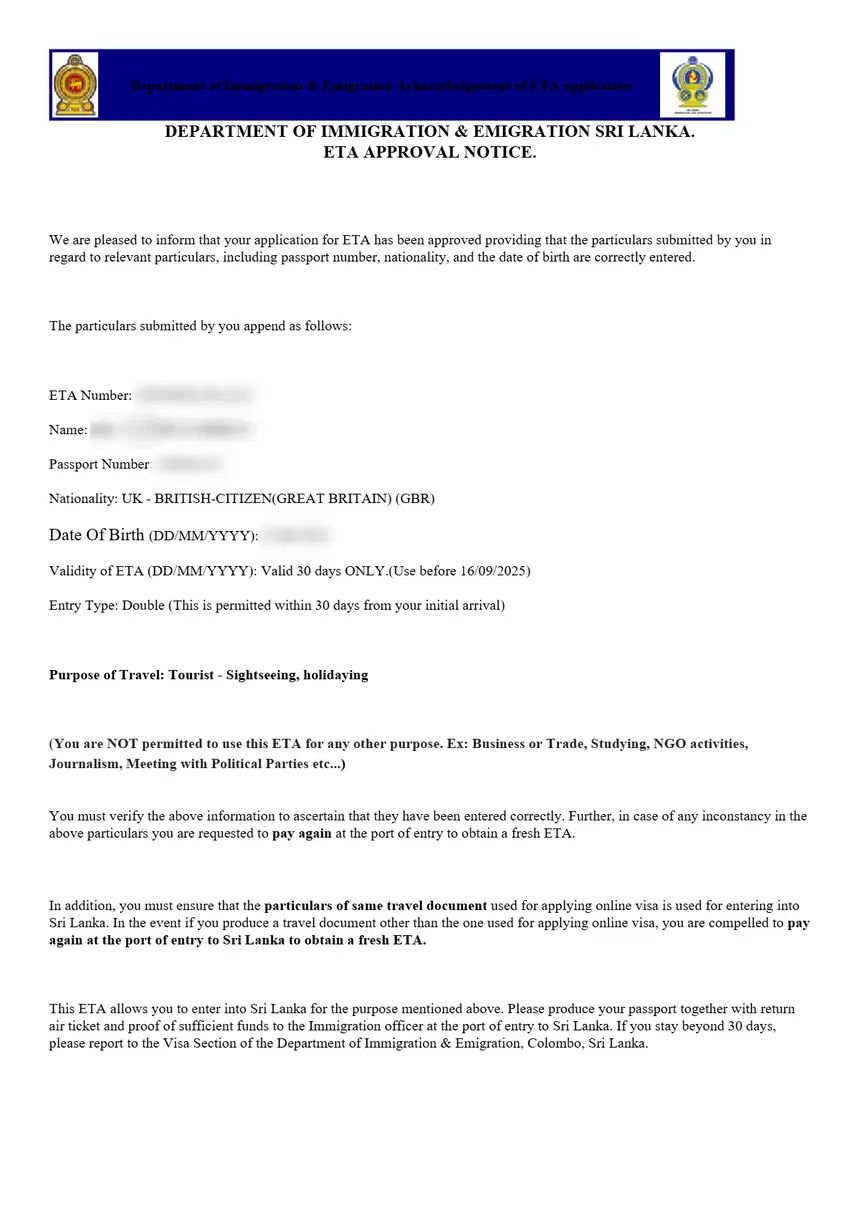
The ETA system was introduced to streamline the entry process and reduce wait times at Sri Lankan ports of entry. Instead of visiting an embassy or consulate, travelers complete a simple online application and receive their authorization via email. The Sri Lanka ETA covers three main travel purposes: tourism, business activities, and transit through Sri Lankan airports.
Unlike a traditional visa that requires physical documentation and embassy appointments, the ETA is processed digitally. Once approved, the authorization is linked to your passport number, and immigration officers can verify it electronically upon your arrival in Sri Lanka. The official portal for all ETA applications is eta.gov.lk, which is the only authorized platform for submitting requests.
The ETA system applies to travelers from over 190 countries worldwide. Whether you are planning a beach holiday in Bentota, attending a business conference in Colombo, or connecting through Bandaranaike International Airport, the ETA is your gateway to entering Sri Lanka legally and efficiently.
Sri Lanka ETA Types
Sri Lanka offers three distinct ETA categories, each designed for specific travel purposes. Understanding the differences between these types helps you select the correct authorization for your trip.
Tourist ETA is the most common type, issued to travelers visiting Sri Lanka for leisure, sightseeing, visiting friends and family, or attending cultural events. This ETA permits a stay of up to 30 days from the date of entry and can be extended to a maximum of 90 days. The tourist ETA costs USD 35 and allows either single or double entry during its validity period.
Business ETA is designed for travelers engaging in commercial activities such as attending meetings, conferences, trade exhibitions, or short-term business consultations. The business ETA also permits a 30-day stay and costs USD 40. Holders of a business ETA are not authorized to take up employment in Sri Lanka – for work purposes, a separate work visa is required through the Department of Immigration.
Transit ETA is available for travelers passing through Sri Lanka en route to another destination. If your layover exceeds 48 hours, you will need a transit ETA. For transits under 48 hours, the ETA is free of charge. Transit ETA holders must have confirmed onward travel documentation and are generally restricted to the airport vicinity or designated transit zones.
Each ETA type has specific documentation requirements and permitted activities. Applying for the wrong type can result in complications at immigration, so verify your travel purpose before submitting your application.
Who Needs a Sri Lanka ETA?
Citizens of most countries worldwide need an ETA to enter Sri Lanka. The requirement applies to over 190 nationalities, making the ETA a near-universal entry requirement for foreign visitors.
Standard ETA required: Travelers from the United States, United Kingdom, Canada, Australia, European Union member states, Japan, South Korea, China, and most other nations must obtain an ETA before arrival or upon landing in Sri Lanka.
SAARC member states: Citizens of South Asian Association for Regional Cooperation (SAARC) countries, including India, Pakistan, Bangladesh, Nepal, Bhutan, Maldives, and Afghanistan, are eligible for reduced ETA fees or fee waivers under regional agreements. Indian citizens, for example, benefit from significantly reduced visa fees as part of bilateral arrangements.
Exempt nationalities: A small number of countries have visa exemption agreements with Sri Lanka. Citizens of Singapore, Maldives, and Seychelles can enter Sri Lanka without an ETA for short stays. However, even exempt travelers should verify current requirements before departure, as policies can change.
Diplomatic and official passport holders from certain countries may be exempt from ETA requirements under bilateral agreements. These travelers should check with the Sri Lankan embassy in their country for specific provisions.
All travelers, regardless of nationality, must hold a passport valid for at least six months from the date of entry into Sri Lanka.
How to Apply for Sri Lanka ETA
Applying for a Sri Lanka ETA is a straightforward online process that takes approximately 15-20 minutes to complete. Follow these steps for a successful application:
Step 1: Visit the official portal. Navigate to eta.gov.lk, the only authorized website for Sri Lanka ETA applications. Beware of unofficial third-party websites that charge additional service fees.
Step 2: Select your ETA type. Choose between Tourist ETA, Business ETA, or Transit ETA based on your travel purpose. Each type has different fees and permitted activities.
Step 3: Complete the application form. Enter your personal details exactly as they appear on your passport, including full name, date of birth, nationality, passport number, and passport expiry date. Any discrepancies between your application and passport can result in delays or rejection.
Step 4: Upload supporting documents. You will need to provide a scanned copy of your passport bio-data page and a recent passport-sized photograph. Some applicants may be asked to provide additional documentation such as return flight tickets or hotel reservations.
Step 5: Pay the ETA fee. Payment is accepted via credit card or debit card. The fee varies by ETA type: USD 35 for tourist, USD 40 for business, and free for transit under 48 hours. SAARC nationals may receive reduced rates.
Step 6: Submit and wait for approval. After submission, you will receive a confirmation email. Standard processing takes 24-72 hours. Your approved ETA will be sent to your registered email address.
Step 7: Print or save your ETA. While the ETA is electronically linked to your passport, it is recommended to carry a printed copy or digital copy on your phone when traveling. Present it along with your passport at the immigration counter upon arrival.
On-arrival option: Travelers who could not apply in advance can obtain an ETA at the Bandaranaike International Airport immigration counter. However, applying online before departure is strongly recommended to avoid potential delays at arrival.
Sri Lanka ETA Fees
The Sri Lanka ETA fee structure is based on your travel purpose and nationality. Understanding the costs helps you budget for your trip accurately.
Standard fees by ETA type:
| ETA Type | Fee (USD) | Validity | Entry Type |
|---|---|---|---|
| Tourist | $35 | 30 days | Single/Double |
| Business | $40 | 30 days | Single/Double |
| Transit (over 48 hrs) | $35 | 48 hours | Single |
| Transit (under 48 hrs) | Free | 48 hours | Single |
SAARC nationals benefit from reduced fees under regional agreements. Indian citizens, for example, pay approximately USD 20 for a tourist ETA. Citizens of other SAARC countries should check the eta.gov.lk portal for their specific rates.
Fee waiver program: Sri Lanka has introduced tourist visa fee waivers for citizens of 40 countries as part of tourism promotion initiatives. This program periodically changes, so check the official portal for current eligibility.
Payment methods: The ETA fee is paid online during the application process. Accepted methods include Visa, MasterCard, and American Express credit or debit cards. The fee is non-refundable even if your application is rejected.
Children and minors: Children of all ages, including infants, require their own ETA. The fee for children is generally the same as for adults, though some nationalities may have exemptions for minors under a certain age.
Important: The ETA fee covers only the authorization itself. It does not include any additional charges such as airport taxes, which are typically included in your airline ticket price.
Sri Lanka ETA Requirements
Before starting your ETA application, ensure you have all the necessary documents and meet the eligibility criteria.
Mandatory requirements:
- Valid passport: Your passport must be valid for at least six months from your intended date of entry into Sri Lanka. Ensure your passport has at least one blank page for entry stamps.
- Recent photograph: A passport-sized photo taken within the last six months, showing your full face against a white background. Digital uploads must be clear and meet standard passport photo specifications.
- Return or onward travel proof: You may be asked to provide evidence of your return flight booking or onward travel arrangements to demonstrate that you intend to leave Sri Lanka before your ETA expires.
- Accommodation details: Hotel reservations or a letter of invitation from your host in Sri Lanka. Business travelers should carry an invitation letter from the Sri Lankan company they intend to visit.
- Sufficient funds: While not always checked at the application stage, immigration officers may ask for proof that you have adequate financial resources to support your stay in Sri Lanka.
Business ETA additional requirements:
– Letter of invitation from a registered Sri Lankan business
– Details of the company or organization you will be visiting
– Purpose and duration of your business activities
Photo specifications:
– Dimensions: 35mm x 45mm (standard passport size)
– Background: Plain white or light-colored
– Expression: Neutral, eyes open, looking directly at the camera
– No head coverings except for religious purposes
– Glasses should be removed to avoid glare
Failure to meet these requirements is one of the most common reasons for ETA application delays or rejections. Double-check all documents before submission.
Sri Lanka ETA Processing Time
Understanding the processing timeline helps you plan your application and avoid last-minute travel disruptions.
Standard processing: Most ETA applications are processed within 24-72 hours (1-3 business days). The Department of Immigration reviews applications during standard working hours, so applications submitted on weekends or Sri Lankan public holidays may take longer.
Recommended application timing: Apply for your ETA at least one week before your planned departure date. This buffer accounts for any unexpected delays, additional document requests, or technical issues with the application system.
Peak season delays: During Sri Lanka peak travel seasons (December-March and July-August), processing times may extend due to higher application volumes. Plan accordingly and apply early during these periods.
Application status tracking: You can check your ETA status through the official eta.gov.lk portal using your application reference number and passport details. The portal provides real-time updates on whether your application is pending, approved, or requires additional action.
Urgent processing: While there is no officially designated expedited service, some applications are processed within hours if submitted during working hours with all complete documentation. However, relying on fast processing is not recommended.
Common processing delays:
– Incomplete or inaccurate application forms
– Poor quality passport scan or photograph
– Mismatch between application details and passport information
– Additional security screening for certain nationalities
– High application volumes during holiday seasons
If your application has not been processed after 5 business days, contact the Department of Immigration through their official channels listed on immigration.gov.lk.
Sri Lanka ETA Validity and Duration
The Sri Lanka ETA has specific validity periods and stay limits that all travelers must understand to avoid overstaying.
Validity period: The ETA is valid for six months from the date of approval. This means you must enter Sri Lanka within six months of receiving your authorization. If you do not enter within this period, you will need to apply for a new ETA.
Duration of stay: Once you enter Sri Lanka, your ETA permits a maximum stay of 30 days from the date of entry. This applies to all three ETA types (tourist, business, and transit), though transit ETA may have shorter permitted stays depending on circumstances.
Entry type: Tourist and business ETAs are typically issued as double-entry authorizations, meaning you can leave and re-enter Sri Lanka once during your validity period. Transit ETAs are single-entry only.
Overstay penalties: Overstaying your authorized period in Sri Lanka is a serious immigration violation. Penalties include fines, detention, deportation, and potential bans on future entry. If you need to extend your stay, apply for an extension before your 30-day period expires.
Counting your stay: The 30-day count begins on the day you enter Sri Lanka, not the day your ETA was approved. For example, if your ETA was approved on January 1 and you enter Sri Lanka on January 15, your authorized stay extends until February 14.
Passport validity interaction: Your passport must remain valid for at least six months beyond your intended departure date from Sri Lanka. If your passport expires within this window, renew it before applying for an ETA.
Country-Specific ETA Information
While the ETA system applies uniformly to most nationalities, there are important country-specific variations in fees, processing, and requirements.
United States citizens: US passport holders need a standard ETA and pay the full fee (USD 35 for tourist, USD 40 for business). Applications are typically processed within 24-48 hours. US citizens can apply online or obtain an ETA on arrival at the airport.
United Kingdom citizens: UK passport holders follow the same process as US citizens with standard fees and processing times. The UK is one of the largest source markets for Sri Lankan tourism, and applications from UK residents are generally processed efficiently.
Indian citizens: As a SAARC member state, India benefits from reduced ETA fees. Indian nationals pay approximately USD 20 for a tourist ETA. Given the proximity and high travel volume between India and Sri Lanka, processing is typically fast, often within 24 hours.
Australian and Canadian citizens: Standard ETA fees and processing apply. Both nationalities must ensure their passports have six months validity from entry date.
EU member state citizens: All EU nationals require an ETA with standard fees. Processing times are generally within the 24-72 hour window.
Chinese citizens: Chinese passport holders need a standard ETA. Processing may occasionally take slightly longer due to additional verification steps.
SAARC country nationals (Pakistan, Bangladesh, Nepal, Bhutan, Maldives, Afghanistan): Benefit from reduced fees under regional agreements. Some SAARC nationals may be eligible for visa-free entry for short stays, so check the current policy before applying.
Checking your specific requirements: The eta.gov.lk portal allows you to select your nationality and view the exact fees and requirements applicable to you. Always verify current requirements as policies are subject to change.
Sri Lanka ETA Extension
If you wish to stay in Sri Lanka beyond your initial 30-day authorized period, you can apply for an ETA extension through the Department of Immigration.
Extension eligibility: All ETA holders (tourist, business, and transit) can apply for an extension, provided they apply before their current authorization expires. Overstaying before applying for an extension may result in penalties.
Extension duration: The standard extension grants an additional 60 days beyond the original 30-day stay, bringing the total maximum stay to 90 days. Extensions beyond 90 days require a different visa category and must be processed at the Department of Immigration head office in Colombo.
How to apply for an extension:
- Visit the e-Services portal at eservices.immigration.gov.lk
- Create an account or log in with your existing credentials
- Select the visa extension option
- Enter your current ETA details and passport information
- Upload required documents (passport copy, current ETA, proof of accommodation)
- Pay the extension fee (approximately USD 30-50 depending on the extension type)
- Submit the application and await approval
Processing time for extensions: Extension requests are typically processed within 3-5 business days. It is advisable to apply at least one week before your current ETA expires to ensure continuity of your legal stay.
In-person extensions: You can also visit the Department of Immigration office at No. 41, Ananda Rajakaruna Mawatha, Colombo 10 for in-person extension processing. Bring your passport, current ETA documentation, and extension fee payment.
Multiple extensions: Generally, only one extension is granted per entry. If you need to stay beyond 90 days, you will need to exit Sri Lanka and re-enter with a new ETA, or apply for a different visa category.
Common Reasons for ETA Rejection
Understanding why ETA applications are rejected helps you avoid common mistakes and increase your approval chances.
Incomplete documentation: The most frequent reason for rejection is submitting an incomplete application. Missing passport scans, unclear photographs, or unanswered questions on the form can trigger an automatic rejection. Ensure every field is completed and all uploaded documents are clear and legible.
Passport validity issues: If your passport expires within six months of your intended entry date, your application will be rejected. Check your passport expiry date before applying and renew if necessary.
Incorrect personal details: Any mismatch between the information on your application and your passport will cause rejection. Pay special attention to spelling of your name, date of birth format, and passport number.
Previous immigration violations: Travelers who have previously overstayed in Sri Lanka, been deported, or violated immigration laws may have their ETA applications denied. Past violations are recorded in the immigration system and affect future applications.
Security concerns: Applications flagged during security screening may be rejected or placed under extended review. This applies to travelers from certain regions or those with specific travel histories.
Duplicate applications: Submitting multiple applications for the same travel dates can cause confusion in the system and result in rejection. Submit only one application per trip.
How to avoid rejection:
– Double-check all information before submission
– Ensure passport scan is high quality and fully legible
– Use a recent, specification-compliant photograph
– Verify passport has six months validity
– Apply through the official eta.gov.lk portal only
– Keep your application reference number for tracking
After rejection: If your application is rejected, you can reapply with corrected information. There is no mandatory waiting period, but ensure you address the specific reason for the previous rejection before resubmitting. The rejection notice will indicate the reason for denial.
ETA vs Regular Visa: Key Differences
Choosing between an ETA and a regular visa depends on your travel purpose, duration, and nationality. Understanding the differences helps you select the right option.
Processing speed: The ETA is significantly faster, typically processed in 24-72 hours online. Regular visa applications through an embassy or consulate can take 5-15 business days or longer, depending on the embassy workload and your nationality.
Application method: ETA applications are submitted entirely online through eta.gov.lk. Regular visas require visiting a Sri Lankan embassy or consulate in person, or mailing your application with original documents.
Cost: ETAs are generally cheaper (USD 35-40) compared to regular visas, which can range from USD 50-200 depending on the visa category and processing speed selected.
Duration of stay: ETAs permit a maximum stay of 90 days (with extension). Regular visas can authorize longer stays, with some categories allowing stays of one year or more for employment, study, or residence purposes.
When to choose an ETA:
– Short-term tourism (up to 90 days)
– Business visits (meetings, conferences, short consultations)
– Transit through Sri Lanka
– Quick entry requirement (within days)
When to choose a regular visa:
– Employment or work purposes
– Long-term study programs
– Residence or family reunification
– Activities not covered by ETA categories
Multiple entry considerations: ETAs are typically double-entry, while regular visas can be issued as multiple-entry with longer validity periods, making them more suitable for frequent travelers to Sri Lanka.
FAQ (Frequently Asked Questions)
Do I need an ETA to enter Sri Lanka?
Yes, citizens of most countries need an ETA to enter Sri Lanka. The ETA is required for tourism, business, and transit purposes. Only citizens of a few exempt countries (such as Singapore and Maldives) can enter without an ETA. Check your specific nationality requirements on the official eta.gov.lk portal.
How early should I apply for a Sri Lanka ETA?
Apply at least one week before your departure date. Standard processing takes 24-72 hours, but applying early allows time for any unexpected issues. During peak travel seasons (December-March and July-August), consider applying two weeks in advance. The ETA is valid for six months from approval, so early application does not affect your travel dates.
Does Sri Lanka ETA cost money?
Yes, the standard tourist ETA costs USD 35 and the business ETA costs USD 40. Transit ETAs for stays under 48 hours are free. SAARC country nationals (India, Pakistan, Bangladesh, etc.) may receive reduced fees. Some nationalities are eligible for fee waivers under tourism promotion programs. Children pay the same fee as adults.
Can I get ETA at the airport in Sri Lanka?
Yes, on-arrival ETA processing is available at Bandaranaike International Airport for travelers who could not apply online in advance. However, applying online before departure through eta.gov.lk is strongly recommended to avoid potential queues and delays at the airport immigration counter.
How long does Sri Lanka ETA take to process?
Standard processing takes 24-72 hours (1-3 business days). Applications submitted during Sri Lankan working hours on business days are typically processed faster. Weekend and holiday submissions may take longer. There is no officially designated expedited processing service, though well-prepared applications are sometimes approved within hours.
What documents do I need for Sri Lanka ETA?
You need a valid passport with at least six months validity from entry date, a recent passport-sized photograph, proof of return or onward travel, and accommodation details in Sri Lanka. Business travelers also need an invitation letter from a Sri Lankan company. All documents must be clear and legible when uploaded.
How long can I stay in Sri Lanka with an ETA?
The standard ETA permits a stay of 30 days from your date of entry. You can apply for an extension of up to 60 additional days through the Department of Immigration e-Services portal, bringing the maximum total stay to 90 days. Overstaying your authorized period results in fines and potential future entry bans.
Can I extend my Sri Lanka ETA?
Yes, you can extend your ETA through the e-Services portal at eservices.immigration.gov.lk. The standard extension adds 60 days to your initial 30-day stay, for a maximum total of 90 days. Apply before your current authorization expires. The extension fee is approximately USD 30-50, and processing takes 3-5 business days.
Is Sri Lanka ETA the same as a visa?
The ETA serves a similar purpose to a visa but is processed entirely online and is faster to obtain. ETAs cover short-term stays up to 90 days for tourism, business, and transit. Regular visas are needed for employment, long-term study, or residence. The ETA is linked electronically to your passport, while traditional visas are physical stamps or stickers.
What happens if my Sri Lanka ETA application is rejected?
If rejected, you can reapply with corrected information. Common rejection reasons include incomplete documents, passport validity issues, and data mismatches. The rejection notice specifies the reason for denial. Address the issue before resubmitting. There is no mandatory waiting period between applications, but ensure all corrections are made to avoid repeated rejections.
Do children need a separate Sri Lanka ETA?
Yes, every traveler including infants and children of all ages needs their own individual ETA. The fee for children is generally the same as for adults. Each child must have their own valid passport, and a separate application must be submitted for each child traveling to Sri Lanka.
Can I work in Sri Lanka with an ETA?
No, the ETA does not authorize employment in Sri Lanka. Business ETA holders can attend meetings, conferences, and short-term consultations but cannot take up paid or unpaid employment. For work purposes, you need to apply for a separate work visa through the Department of Immigration and Emigration with employer sponsorship.